The Truth About Cheap AC Tune-Ups in Central Connecticut
Every spring, mailers and ads across Durham, Middletown, Middlefield, and Killingworth promote cut-rate AC tune-ups. The price looks good. The visit often is not. Homeowners who call in June with upstairs bedrooms stuck at 84 degrees almost always had a drive-by service visit the year before. This article explains what a real AC maintenance visit in central Connecticut includes, why the price should land in a realistic 2026 range, and how local conditions along Route 17, Route 79, and Route 68 influence what matters most during an inspection. The focus stays on AC maintenance Durham CT because the local housing stock and climate patterns change what a proper tune-up must catch.
Central Connecticut sits in climate zone 5A with summer design temperatures around 86 to 88 degrees. Cooling equipment runs at part-load most days, then spikes during late June heat and again in late August when humidity surges off the Connecticut River. That pattern creates specific failure trends. A disciplined tune-up addresses those trends. A cheap tune-up usually does not.
What a proper AC maintenance visit covers in Middlesex County
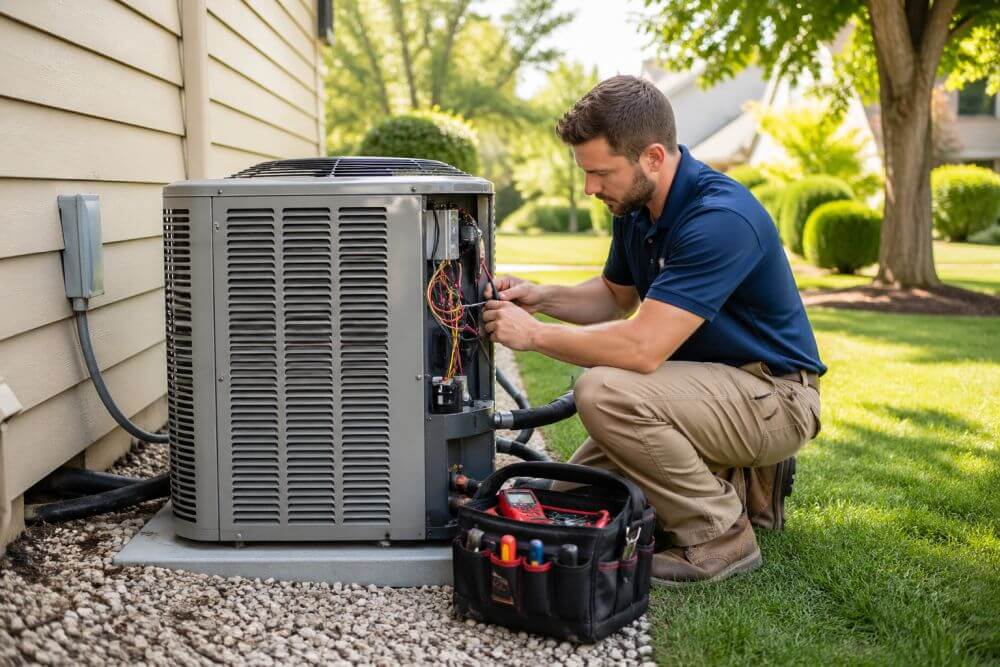
AC maintenance Durham CT means fieldwork on real equipment in basements, attics, garages, closets, and rooftop curbs. A proper visit verifies refrigerant charge by measuring superheat and subcooling. It confirms the system moves enough air by checking static pressure across the air handler and coil. It cleans the outdoor condenser coil so the compressor can shed heat. It measures electrical health so a small weakness does not turn into a midsummer outage. It also handles basic hygiene that protects property, like clearing the condensate drain so it does not overflow onto a finished basement floor in Meriden or a first-floor ceiling in Madison Beach homes.
Technicians across Durham, Middletown, and Wallingford report the same root causes for AC performance loss. The first is a dirty condenser coil. The second is a weak run capacitor. The third is a plugged condensate drain. Those three items together account for more than half of the no-cool calls seen along the Route 9 corridor each summer. A real tune-up solves these preventively.
Central Connecticut costs that make sense in 2026
Pricing tells a story. In 2026, a single-system basic AC maintenance visit in Middlesex County usually falls between $120 and $250, depending on access, equipment age, and whether the indoor coil is accessible for inspection. A premium multi-point tune-up with deeper electrical testing, airflow measurement, and drain line clearing typically runs $200 to $400. Annual maintenance plans that include both cooling and heating service for the same system usually run $300 to $600, with priority scheduling during the first 90-degree week of July in towns like Cromwell and Guilford.
A $39 or $59 tune-up coupon cannot cover a proper visit in central Connecticut. That price often funds a quick visual check followed by a sales pitch. Homeowners then face a preventable repair later. The most common example is a $150 maintenance visit that finds and replaces a failing capacitor before it strands a family during the Durham Fairgrounds fundraising weekend. Skip the check and that same capacitor becomes a $300 to $400 repair during business hours, often plus a $150 to $200 after-hours premium if it fails at 7 pm in late August. The math favors real maintenance.
The local pattern few people expect
There is a seasonal capacitor failure clustering pattern across Durham, Middletown, and Middlefield that bears calling out. Roughly 70 percent of air conditioner capacitor failures in this service area occur in the first two weeks of June and the last week of August. The reason is simple physics. The most severe thermal cycling on older capacitors happens when weather shifts quickly from mild to hot in early June and when late-season heat waves follow cool nights in late August. Maintenance that measures microfarads against the nameplate rating in May catches weak parts before those swings hit. This single check prevents many no-cool calls along Main Street Durham and in the Westfield and Long Hill sections of Middletown.
What “cheap” skips and why that causes trouble on Route 17 in July
Loss-leader AC service calls tend to be short and superficial. They usually skip coil cleaning, actual electrical measurements, and airflow verification. They often do not check the condensate safety float switch. They almost never test refrigerant charge with both subcooling and superheat. Those omissions line up perfectly with the top failure modes in central Connecticut. A short visit cannot prevent what a long, humid July weekend on Route 17 will cause.
The Durham and Higganum housing mix amplifies this problem. Many ranch and split-level homes built from the 1950s through the 1980s have retrofitted ductwork. Those ducts can run high static pressure when paired with modern high-efficiency indoor coils. A quick filter change does not address that. A tune-up that measures static pressure at the supply and return and checks blower motor amperage can flag a growing airflow problem before it freezes the evaporator coil on an 88-degree afternoon.
Technical ground truth: what a thorough AC maintenance includes
Most homeowners do not want a tutorial. They want the work done right. Still, clarity helps sort real service from a coupon visit. The following items are the core of a professional AC maintenance Durham CT appointment on a central air system using R-410A, R-454B, or R-32 refrigerant.
- Refrigerant charge verification using subcooling and superheat, translated to plain English along with any correction needed. Condenser coil cleaning with the right solution, water pressure controlled to avoid fin damage, and debris cleared from the base. Electrical inspection that measures capacitor microfarads, checks contactor wear, confirms compressor and fan amperage draw, and tightens high-voltage and low-voltage connections. Airflow checks: filter condition, blower wheel cleanliness, blower motor amperage, and static pressure across the coil and air handler to find duct issues early. Condensate drain clearing and test of any float switch so overflows do not damage finishes in a 06457 Middletown colonial or a 06443 Madison shore home.
Beyond those items, a quality visit will inspect the indoor evaporator coil when accessible, verify thermostat calibration, and note any duct leakage that should be addressed by duct sealing. Where zoning is present, the technician will confirm damper operation at the zone control panel. If a communicating thermostat such as American Standard AccuLink, Trane ComfortLink, Carrier Infinity, or Lennox iComfort is installed, the technician will review stored alerts and run system tests through the interface.
Refrigerant types in 2026 and what that means in practice
Central Connecticut systems installed from 2010 through 2024 typically use R-410A. Beginning in 2025 and 2026, many new systems ship with lower global warming potential refrigerants such as R-454B or R-32, both classified as A2L refrigerants. An A2L refrigerant is mildly flammable under specific conditions. That classification does not change the basic goals of AC maintenance, but it does change safety practices for service work. EPA 608 certification is required for all refrigerant handling. Technicians use appropriate tools, avoid ignition sources during service, and follow manufacturer procedures.
Homeowners should expect competent handling of any refrigerant type. Charge verification remains the same engineering principle: the system must move a set amount of heat, and the refrigerant circuit must be charged so the expansion device and coil surfaces perform as designed. Subcooling and superheat, taken together with outdoor ambient temperature and indoor return air conditions, provide the answer.
Durham and Middletown housing archetypes change the maintenance playbook
Colonials along Main Street in Durham Center and farmhouses near the Coginchaug River often pair hydronic heat with retrofit air conditioner maintenance central air handlers in the attic. Those systems need extra attention on drain safeties because a clogged line can stain second-floor ceilings. Split-levels in Middlefield and Rockfall with basement air handlers need disposable media filters sized correctly to avoid high static and reduced airflow. Newer construction north of Durham Center with tightly sealed envelopes sometimes shows higher indoor humidity when the AC short cycles. Correct thermostat configuration and inspection of the TXV, or thermostatic expansion valve, can help stabilize runtime and reduce moisture.
In Madison and Guilford near Long Island Sound, salt and coastal moisture load the condenser coil with a film that insulates fins. Annual coil cleaning is essential there. In Wallingford and Cheshire along I-91, pollen in late spring gets trapped in the outdoor coil. Cleaning the coil before the first 90-degree day matters more than many homeowners expect. If the coil cannot reject heat, even a perfectly charged system will drift warm.
Commercial rooftop units along Route 9 and I-91 need tuned basics, not shortcuts
Small businesses in Middletown near Route 9 and in Meriden near I-91 often run 5 to 15 ton packaged rooftop units. These units face different wear, but the same discipline applies. A cheap check that does not inspect the contactor and condenser fan motors will miss problems that cause a Monday morning no-cool, lost sales, and an emergency call. A real commercial PM will clean the coils, verify economizer function where installed, check belt tension on belt-driven supply fans, record compressor amps, and confirm the control board staging logic. The visit should document EER2 performance at a known outdoor temperature so facilities teams can track drift over time.
Why the contactor and capacitor deserve special attention in this market
In Durham, Middletown, and Killingworth, the two most common electrical wear parts are the run capacitor and the contactor. The capacitor provides a phase shift that helps motors start and run at the proper torque. Heat and age drive its value out of specification. The contactor is a high-current switch. Each start forms a tiny arc that pits its surfaces. At first there is noise or a flicker of hesitation. Then the unit will not start at all. Measuring microfarads on the capacitor and inspecting contactor faces during AC maintenance Durham CT takes minutes and prevents weeks of frustration during peak season.
Airflow and static pressure: why guesswork fails in 06422 and 06457
Air conditioners do not cool air without the right airflow. Many older homes in 06422 Durham and 06457 Middletown have return ducts that are too small for a modern evaporator coil paired with a variable-speed ECM blower. The result is high total external static pressure. The system may move only 70 to 80 percent of the required CFM. Symptoms show up as uneven cooling, longer runtimes, and frozen evaporator coils. A careful tune-up will capture static pressure, compare it against the air handler’s rated maximum, and note the adjustment needed. That may be as simple as a larger filter rack, an added return grille, or resealing a leaky return trunk with mastic instead of tape.
Condensate control that respects finished basements and attics
Homes across Middlefield near Lake Beseck and Powder Ridge often feature finished basements. Many attics in Haddam Center and Madison Beach hold air handlers above drywall ceilings. In both cases, condensate control matters. Clearing the drain, verifying slope, checking the trap, and testing float switches are not optional. The technician should pour water through the drain pan to confirm flow. Where pumps are installed to lift condensate to a drain, the pump should be tested under load. These steps take minutes and prevent expensive water damage.
Thermostat calibration and control logic that match central Connecticut living patterns
Smart thermostats such as Nest, Ecobee, Honeywell, and American Standard AccuLink add features, but they also add configuration. A maintenance visit should confirm cool setpoints, differential, cycle rate, and dehumidification settings where supported. Improper configuration can cause short cycling in tightly built 2010s colonials in North Madison or slow recovery in older Durham farmhouses. For communicating systems like American Standard and Trane, the thermostat can run built-in diagnostics that help a technician verify staging and blower profiles. That work belongs in a professional AC maintenance Durham CT appointment.
Maintenance plans: who benefits and what to ask for
Annual plans in central Connecticut make sense for two groups. The first is homeowners with equipment 10 to 20 years old. Small issues on older systems compound quickly, and priority scheduling is valuable during a heat wave along the Route 17 corridor. The second is households with finished spaces at risk from condensate issues, like attic systems above bedrooms in East Hampton or a basement air handler under a first-floor kitchen in Cromwell. A fair plan includes one cooling visit and one heating visit, documented measurements, and a clear list of covered tasks. It should offer parts discounts but not bury conditions in fine print.
Red flags that signal a loss-leader visit
- The entire visit ends in 20 minutes or less with no coil cleaning and no electrical readings recorded. No mention of superheat or subcooling and no pressure-temperature readings taken. No static pressure measurement and no discussion of airflow even when rooms feel uneven. No condensate drain test and no float switch test when the air handler sits above finished spaces. Immediate pressure to replace equipment before any inspection data is shared.
If a service company cannot show readings, it did not measure. Without measurements, the technician guessed. Guesswork is why so many Middletown systems run on the edge until the first 90-degree Saturday.
Brands, parts, and what matters more than the label
American Standard, Trane, Carrier, Lennox, Bryant, Rheem, Goodman, Bosch, Mitsubishi Electric, and Daikin systems all live in central Connecticut homes. Each brand uses the same physics. The best maintenance finds weak components before they fail. On American Standard systems, for example, testing an AccuLink communicating thermostat’s logs can reveal short cycling that points to a pitted contactor. On Mitsubishi and Daikin ducted or ductless systems, checking drain pans on wall-mounted or ceiling-cassette indoor units is as essential as cleaning outdoor coils. The badge on the cabinet is less important than the readings on the gauges and meter and the cleanliness of the heat exchange surfaces.
Why AC maintenance is different along the Connecticut River and shoreline
Middletown’s proximity to the Connecticut River raises ambient humidity several days each week in July and August. High humidity increases the latent load on the evaporator coil. A dirty coil cannot dehumidify like a clean coil at the same airflow. Along the shoreline in Madison and Guilford, sea air and salt contribute to corrosion. Annual cleaning matters more, and so does checking condenser fan motors for signs of bearing strain from corrosion. Near Cockaponset State Forest in Haddam and Killingworth, spring pollen loads coil fins before summer arrives. Waiting until late June to clean an outdoor coil there is late.
Energy performance and SEER2 expectations after a tune-up
SEER2 is the efficiency rating that governs new AC equipment installed under 2023 federal standards. Maintenance will not turn a 14.3 SEER2 unit into a 17 SEER2 unit, but it will allow the system to run at its rated performance. That means the compressor runs fewer minutes per hour to do the same work. The blower pulls the designed airflow in CFM rather than fighting a dirty filter or coil. The contactor closes cleanly so voltage delivery stays steady. These small details show up on the bill in Wallingford, Cheshire, and Meriden when July usage spikes. The goal of AC maintenance Durham CT is not magic. It is restoring the system to factory-intended operation.
For properties near the Durham Fair Grounds and along Maiden Lane
Events bring guests, and guests bring higher internal loads. Homes within a mile of the Durham Fair Grounds often host extended family during late summer. Equipment that barely holds temperature now will not hold temperature with eight extra people and a running oven. A May or early June tune-up that confirms airflow, charge, and electrical health keeps homes comfortable for these weeks. That same timing works for student apartments near Wesleyan University in Middletown ahead of late August move-in, when the capacitor failure clustering described earlier shows up most.
Why documentation matters for homeowners and facility managers
A maintenance visit without documentation is a missed opportunity. A short report that lists refrigerant readings, capacitor microfarads, contactor condition, blower amperage, static pressure, and drain test results becomes the baseline for the next year. Facility managers in 06450 and 06451 Meriden already track this for rooftop units. Homeowners should expect the same at a residential scale. If a blower motor fails in July, data from May will show whether amperage had been drifting high. If superheat was borderline, a slow refrigerant leak can be addressed before it grows into a frozen evaporator coil and a Saturday emergency call.
What heating-dominated Connecticut means for cooling service
Central Connecticut logs roughly 6,000 to 6,500 heating degree days and 600 to 800 cooling degree days each year. That is a heating-dominated market. AC equipment spends many hours idling, then faces sharp demand spikes. Components like capacitors and contactors suffer more from long idle periods followed by hard starts than they do from steady, modest use. This is why pre-season AC maintenance in Durham, Higganum, and Rockfall catches so many easy-to-fix issues. The equipment sits all winter while furnaces, boilers, or heat pumps carry the load. Then April warms, May teases, and June hits hard. The first starts after a long idle are when marginal parts fail.
How ductless mini-split owners should think about maintenance
Across Madison, Guilford, and Killingworth, many homes use Mitsubishi M-Series, Mitsubishi Hyper-Heat, Daikin, or Fujitsu ductless systems for cooling and supplemental heating. These systems need filter and coil cleaning on the indoor heads and careful cleaning of the outdoor unit coil. Because ductless systems modulate with inverter-driven compressors, they often mask small performance losses until a heat wave arrives. A spring service that removes biofilm and dust from the indoor coil and cleans the condensate path prevents wall streaking and water damage, and it restores heat exchange efficiency. Ductless systems also need electrical checks on the outdoor board, capacitor where present, and verification of lineset insulation condition.
Why AC maintenance in 06422 should reference the equipment’s age
A 5-year-old American Standard or Carrier system in Durham North may need little more than coil cleaning, drain service, and readings. A 15-year-old system along Pickett Lane or Maiden Lane deserves closer electrical testing and airflow scrutiny. Older indoor coils may be partially fouled even if they look clean from the access panel. A maintenance visit should note age-related risks plainly and price small preventive replacements, like a marginal capacitor, sensibly. Homeowners appreciate direct language when it matches the data recorded on the job.
The role of filters, MERV ratings, and media cabinets
Media filter cabinets with MERV 11 to 13 filters are common in newer Middlesex County homes. These do a good job of capturing fine particles from pollen and dust. They also raise static pressure if the cabinet or filter is undersized. During maintenance, the technician should verify the filter size matches the airflow the system needs. A 3-ton system often needs a larger filter area than a 1-inch return grille will provide. Where American Standard AccuClean or similar electronic filtration is installed, the visit should include cleaning of collection cells and verification of operation. Efficient filtration supports cleaner coils and better long-term performance.
What homeowners can expect after a real tune-up in AC maintenance Durham CT
After a proper visit in Durham, Middletown, or Cromwell, the outdoor unit should run with smooth starts and steady fan speed. The indoor air should feel drier on humid days because the coil can transfer heat and moisture effectively. Rooms that ran warmer upstairs should improve if airflow and static numbers came back into range. The system should start, run, and stop cleanly. The report should show readings that match the conditions that day. If the technician flagged a borderline part like a capacitor at 6 percent low on microfarads, homeowners should receive a measured recommendation, not pressure.
Timing that fits the central Connecticut weather curve
For most households along Route 17 and Route 147, the ideal maintenance window runs from mid-April through late May. That gets in front of the early June thermal cycling that takes out marginal capacitors. It also beats the rush that hits the first week a 90-degree forecast lands in the 06416 Cromwell and 06480 Portland zip codes. A second good window opens in early September for systems that ran nonstop in July and August. That visit can address any dirt load on coils ahead of the off-season and document performance while outdoor air is still warm.
Why a locally grounded process matters more than a checklist
Checklists help, but local knowledge closes the loop. A technician who services homes near the Durham Public Library and the Tuttle Road corridor knows how cottonwood and roadside dust load coils differently than systems near Cockaponset State Forest. A tech who has worked in Westfield and South Farms in Middletown knows which attics run hot and which basements run damp. This local context for AC maintenance Durham CT is what separates a real tune-up from a coupon call.
Service reach that actually supports same-day help during a heat wave
Proximity reduces downtime. A company based in 06422 at 57 Ozick Dr Suite i can reach Middletown 06457 quickly via Route 17, then head to Middlefield 06455, Rockfall 06481, Killingworth 06419, Higganum 06441, and Madison 06443 without losing a day in a truck. That geography matters on the first 95-degree day when calls stack up and upstairs bedrooms hit 88 degrees by evening. Crews that know the houses and the roads also know the equipment mix. American Standard, Trane, Carrier, Lennox, Bryant, Rheem, Goodman, Mitsubishi Electric, and Daikin are all common. Having the right contactors, capacitors, and drain fittings on the truck matters when speed matters.
Credentials that matter for maintenance quality in Connecticut
Connecticut requires licensed contractors for HVAC work. An S-1 unlimited heating and cooling license signals full scope capability. EPA 608 refrigerant certification ensures legal and competent refrigerant handling across R-410A, R-32, and R-454B systems. NATE-certified technicians bring standardized testing to the skill set that shows up in the driveway. These items matter because maintenance touches safety systems, electricity, and refrigerant. They are not paperwork. They are a signal that the person tuning a system on Maple Avenue, Maiden Lane, or Higganum Road is trained to protect the home and the equipment.
Direct language on upsells and replacements
Sometimes a tune-up finds bigger issues. A coil may leak. A compressor may draw locked rotor amps and fail to start. A blower motor may overheat. On older equipment, those repairs can approach the value of a replacement. In those cases, homeowners in Durham, Wallingford, and Meriden deserve a clear written quote and time to decide. New equipment discussions can include SEER2 ratings, single-stage versus two-stage or variable-speed compressors, and, where relevant, heat pumps with HSPF2 ratings that make sense for zone 5A winters. Incentive and tax credit discussions, such as Energize CT rebates or federal IRA credits, belong in those conversations, not during a basic AC maintenance Durham CT visit, unless the homeowner asks to explore options based on what the tune-up revealed.
A final word on why a fair price and real work beat coupons every time
A fair maintenance price funds actual labor and real measurements. That is what prevents emergency calls during the first July heat wave and the last August surge. The surprise for many Middlesex County homeowners is how predictable most failures are when someone takes the time to measure, clean, and correct. Central air does not fail at random. It fails where a reading would have pointed six weeks earlier.
Ready to schedule AC maintenance Durham CT
For homeowners and property managers across Durham, Middletown, Middlefield, Killingworth, Haddam, Madison, Guilford, Wallingford, Cheshire, Meriden, Cromwell, Portland, East Hampton, Higganum, and Rockfall, proper AC maintenance Durham CT is available Monday through Saturday on a 24-hour operational schedule for seasonal service and urgent needs. Direct Home Services operates from its Durham headquarters at 57 Ozick Dr Suite i, is a Connecticut Licensed HVAC Contractor under an S-1 unlimited heating and cooling license, and is an American Standard Customer Care Dealer with NATE-certified technicians and EPA 608 refrigerant certification. Expect documented readings, honest findings, and a clean, thorough visit. Call +1 860-339-6001 or request service at https://directhomecanhelp.com/durham-ct/ac-maintenance/ to book AC maintenance Durham CT before the early June capacitor surge and the late August humidity spike arrive.
Direct Home Services provides professional HVAC repair, replacement, and emergency plumbing services in Durham, CT. Our local team serves residential and commercial clients across Middlesex, Hartford, New Haven, and Tolland counties with high-efficiency heating, cooling, and drainage solutions. We specialize in rapid furnace repair, air conditioning installation, and expert drain cleaning to ensure your home remains comfortable and functional year-round. As a trusted local contractor, we prioritize technical precision and transparent pricing on every service call. If you are looking for an HVAC contractor or plumber near me in Durham or the surrounding Connecticut communities, Direct Home Services is available 24/7 to assist.
Direct Home Services
57 Ozick Dr Suite i
Durham,
CT
06422,
USA
Phone: (860) 339-6001
Website: https://directhomecanhelp.com/
Social Media: Facebook | Instagram
Map: Google Maps